India is becoming one of the fastest-growing solar markets in the world. The top solar panel manufacturers in India are playing a major role in this transformation. From large-scale factories to advanced technologies, solar manufacturing companies in India are building a self-reliant solar ecosystem. This guide covers everything — from the list of solar cell manufacturing companies in India to government policies, technology, and future outlook.
What is a Solar Panel Manufacturer?
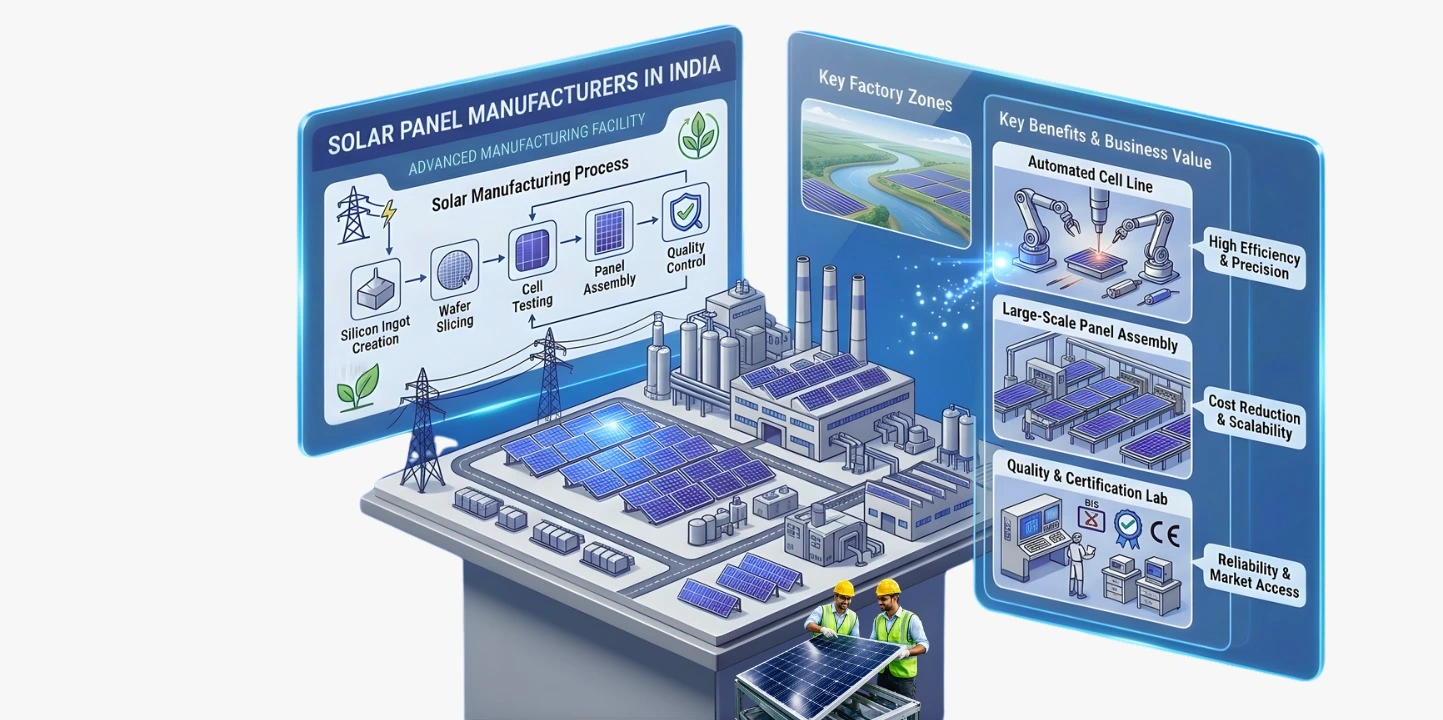
A solar panel manufacturer is a company that produces solar panels using basic raw materials. These panels are designed to convert sunlight into usable electricity for residential and commercial use. The manufacturing process covers multiple stages such as solar cell production, panel assembly, and quality testing.
These companies play a critical role in the solar ecosystem by supplying panels to installers, EPC companies, businesses, and export markets. When users search for the best solar manufacturers in India, they are essentially looking for trusted brands that deliver durable and efficient solar panels.
If you are confused about selecting the right solar manufacturer, taking expert guidance can save you from costly mistakes. We provide solar advisory services to help you choose the best panels based on your budget, location, and energy needs.
In simple words, manufacturers transform materials like silicon into fully functional solar panels that can be installed on rooftops or used in large-scale solar power plants.
Note — Solar Panel Manufacturer Who actually makes the panels at the factory level? Focus: production, capacity, technology. Examples: Waaree Energies, Adani Solar. They manufacture solar cells and modules, sell in bulk (B2B), and export globally.
Role of Solar Panel Manufacturers in the Solar Industry
Solar panel manufacturers play a key role in the solar industry's growth in India. They design, produce, and improve solar panels that generate clean electricity from sunlight. They convert raw materials like silicon into high-performance photovoltaic (PV) modules. These companies help reduce power costs, cut fossil fuel use, and make solar energy more affordable.
These manufacturers not only produce solar panels but also drive innovation. They develop advanced technologies such as Mono PERC, bifacial, and thin-film panels to improve efficiency and performance. This continuous innovation helps lower costs for consumers and supports the shift toward renewable energy.
If you are new to solar, first understand the basics of how solar panels work. Read this detailed guide on what is solar energy and how it generates electricity before choosing a manufacturer.
Production and Innovation
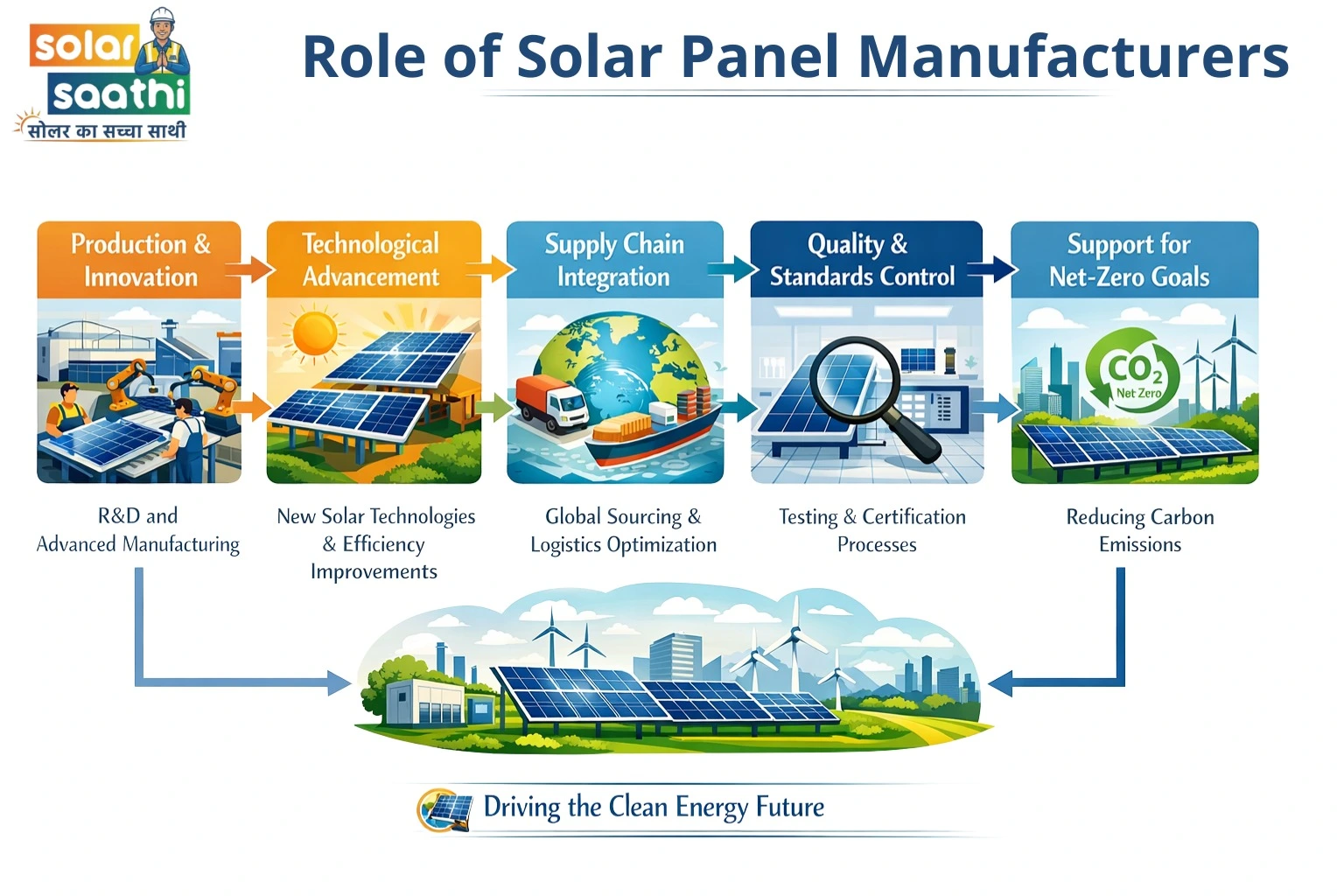
Manufacturers produce durable and high-efficiency solar panels. They design advanced modules like TOPCon and G12 panels. These panels offer better performance and long-term reliability. They suit residential, commercial, and utility-scale projects.
Technological Advancement
Companies invest in research and development to improve solar panel performance. They work on new technologies like bifacial and perovskite panels. These panels generate more energy from both sides. They also perform better in low-light conditions.
Supply Chain Integration
Leading solar panel manufacturers in India expand production under the Make in India solar push. They produce raw materials along with solar panels. This reduces dependency on foreign imports. It also strengthens India's solar manufacturing capacity.
Quality and Standards Control
Manufacturers ensure that solar panels meet strict quality standards such as ALMM approvals. They ensure panels are safe, durable, and consistent in performance over time. This helps maintain consistent performance over many years. Customers get long-term value from their investment.
Enabling Energy Transition
Major solar panel manufacturers in India offer different types of solar panels for various needs — monocrystalline, polycrystalline, and thin-film. This variety makes solar suitable for all users and supports the overall solar industry growth in India.
Support for Net-Zero Goals
Solar manufacturers help reduce carbon emissions in India. They support the country's renewable energy targets. India aims to reach 500 GW capacity by 2030. Manufacturers play a key role in achieving this goal.
Solar panel manufacturers drive both economic development and environmental sustainability. They create jobs and strengthen the local manufacturing sector. At the same time, they promote clean and sustainable energy.
Top 20 Solar Panel Manufacturers in India
India is growing fast in solar energy. The government targets 500 GW by 2030. Solar panel demand is rising every year. Many companies now make high-quality panels in India. The MNRE ALMM list ensures trusted manufacturers. This guide helps you choose the right solar brand.
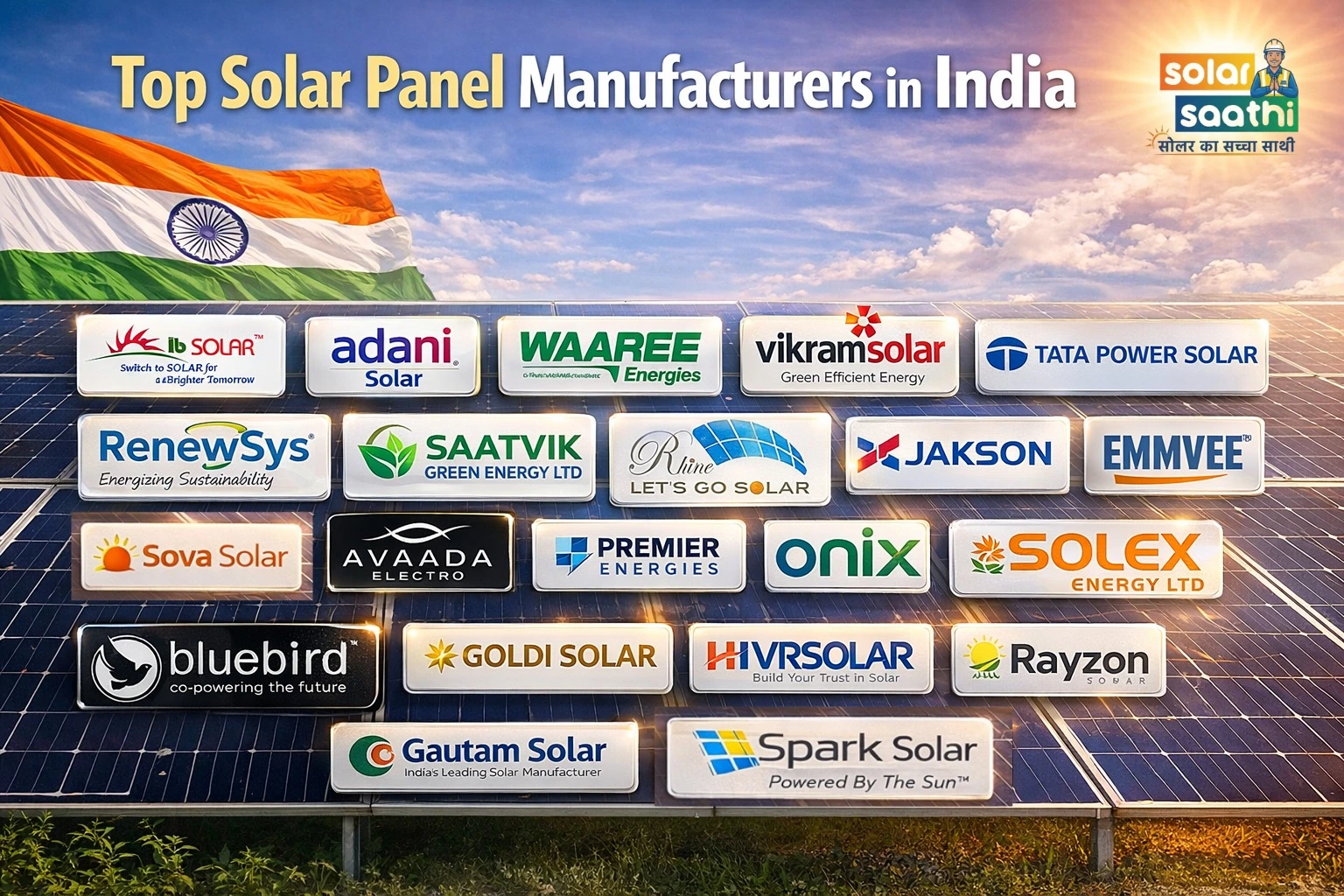
Here is a practical list of solar cell manufacturing companies in India. These companies are driving solar growth across residential and commercial sectors.
IB Solar
(Noida, Hazratpur Wajidpur, Uttar Pradesh)
- Website: ibsolar.co.in
- Phone: +91-99102 22871
- Email: marketing@ibsolar.co.in
Adani Solar
(Ahmedabad, Gujarat, India)
- Website: adanisolar.com
- Phone: 9099906645
- Email: cs@adani.com
Waaree Energies
(Goregaon, Mumbai, Maharashtra, India)
- Website: waaree.com
- Phone: 1800-212-1321
- Email: waaree@waaree.com
Vikram Solar
(Kolkata, West Bengal, India)
- Website: vikramsolar.com
- Phone: 9007018200
- Email: sales@vikramsolar.com
Tata Power Solar
(Mumbai, Maharashtra, India — Est. 1989)
- Website: tatapowersolar.com
- Customer Support: 1800-419-8777
- Email: santoshc@tatapower.com
- Phone: (022) 6717 1000
RenewSys
(Bandra East, Mumbai, Maharashtra, India)
- Website: renewsysworld.com
- Phone: +91-22-68100500
- Email: renewsys@renewsysindia.com
Saatvik Green Energy Ltd
(Barara, Haryana, India)
- Website: saatvikgroup.com
- Phone: 1800-547-1151
- Email: sales@saatvikgroup.com
Rhine Solar
(Production Facility: Kundli, Sonipat, Haryana)
- Website: rhinesolar.in
- Phone: +91 9811292992 / +91 9811078868
- Email: info@rhinesolar.in
Jakson Group
(H.Q: Noida, Uttar Pradesh, India)
- Website: jakson.com
- Phone: 1800 103 2600
- Email: info@jakson.com
Emmvee Group
(Bengaluru, Karnataka, India)
- Website: emmvee.com
- Phone: +91 80 2217 4333
- Email: info@emmvee.in
Avaada Electro Pvt Ltd
(Mumbai, Maharashtra, India)
- Website: avaada.com
- Phone: +91 120 6757000
- Email: avaada@avaada.com
Premier Energies Ltd
(Hyderabad-500081, Telangana, India)
- Website: premierenergies.com
- Phone: +91-40-2774 4415
- Email: sales@premierenergies.com
Onix Renewable Ltd
(Rajkot, Gujarat, India)
- Website: onixrenewable.com
- Phone: +91 73000 17000
- Email: business@onixgroup.in
Solex Energy Ltd
(Surat, Gujarat, India)
- Website: solex.in
- Phone: 1800 572 8787
- Email: info@solex.in
Bluebird Solar Ltd
(Rajasthani Udyog Nagar Industrial Area, GT Karnal Road, Delhi, India)
- Website: bluebirdsolar.com
- Phone: +91-011-47052209
- Email: info@bluebirdsolar.in
Goldisolar
(Navsari, Gujarat - 396445, India)
- Website: goldisolar.com
- Phone: 1800-833-5511
- Email: info@goldisolar.com
HVRSOLAR
(Netaji Subhash Place, Pitampura, Delhi-110034, India)
- Website: hvrsolar.com
- Phone: 1800 212 1716
- Email: info@hvrsolar.com
Rayzonsolar
(Netaji Subhash Place, Pitampura, Delhi-110034, India)
- Website: rayzonsolar.com
- Phone: 9638000461/62
- Email: contact@rayzonenergies.com
Gautam Solar
(New Delhi, India)
- Website: gautamsolar.com
- Phone: +91 93117 97248
- Email: info@gautamsolar.com
Sovasolar
(Kolkata - 700156, West Bengal, India)
- Website: sovasolar.com
- Phone: +91 3345075609
- Email: info@sovasolar.com
Sparksolar
(Off Bhiwandi Bypass, Thane, Mumbai, India)
- Website: sparksolar.in
- Phone: +91 22 48250399
- Email: info@sparksolar.in
Choosing from so many manufacturers can be confusing. We provide solar installer selection consultancy that helps you compare brands and select the most reliable option for your project.
Manufacturing Capacity of Solar Companies in India
India's solar manufacturing sector is expanding at a very fast pace. By March 2026, solar module production capacity crossed 210 GW, largely supported by government initiatives like the PLI scheme and ALMM regulations. At the same time, domestic solar cell manufacturing is scaling up quickly, with a target of crossing 100 GW by December 2027. A major share of this capacity is concentrated in Gujarat.
Key Manufacturing Trends (2025–2026)
| Metric | Current Status |
|---|---|
| Solar Module Capacity | Crossed 210 GW (top 10 manufacturers contribute ~44%) |
| Solar Cell Capacity | Expected to cross 65 GW by June 2026 (up from ~27 GW in Oct 2025) |
| Regional Hub | Gujarat dominates with ~45% of total capacity |
| Technology Shift | TOPCon adoption rising fast; efficiency crossing 23.5% |
| Future Scenario | Capacity may reach 60–65 GW vs demand of ~45–50 GW |
Leading manufacturers driving this GW solar production in India include Waaree Energies, Adani Solar, Vikram Solar, Premier Energies, Emmvee, and Aroma Solar.
Policy Support: Government-backed schemes like the PLI scheme solar India are pushing companies towards fully integrated manufacturing — covering the entire chain from ingots to modules. This is gradually reducing reliance on imports.
Technology Used by Solar Panel Manufacturers
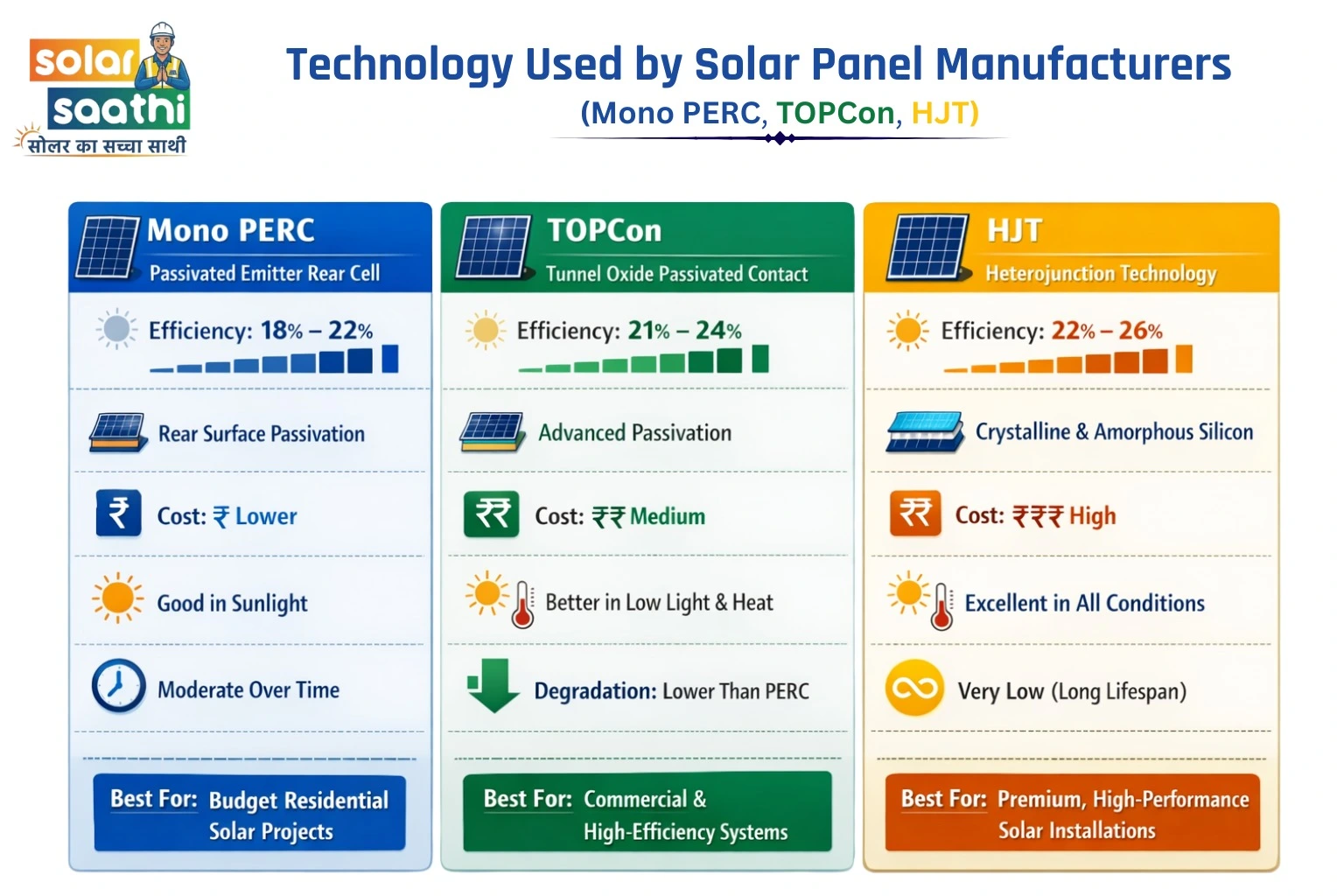
Solar panel technology is improving fast. Manufacturers are moving beyond old methods. They now use advanced technologies for better efficiency and performance.
Mono PERC Technology
Mono PERC is the most common solar technology today. It improves traditional solar cells. A special layer is added at the back side of the cell. This layer reflects unused sunlight back into the cell, so more light gets absorbed and power generation increases. It also works better in low-light conditions like cloudy weather. Mono PERC is widely used because it offers good performance at a lower cost.
- Efficiency: 18% – 22%
- Cost: Lower
- Best for: Budget residential solar projects
TOPCon Technology
TOPCon is an advanced version of Mono PERC technology. It uses a very thin oxide layer inside the cell. This layer reduces energy loss during electricity generation and helps electrons move more efficiently inside the cell. Because of this, TOPCon panels produce more electricity from the same sunlight. Many top solar manufacturing companies in India are upgrading from PERC to TOPCon for better output.
- Efficiency: 21% – 24%
- Cost: Medium
- Best for: Commercial & high-efficiency systems
HJT (Heterojunction Technology)
HJT is one of the most advanced solar technologies available today. It combines crystalline silicon with thin amorphous silicon layers. This improves efficiency and reduces energy loss. It performs very well in high-temperature conditions.
- Efficiency: 22% – 26%
- Cost: High
- Best for: Premium, high-performance solar installations
Additional Improvements
- Bifacial Panels — Generate power from both front and back sides; capture reflected sunlight from the ground
- Half-Cut Cells — Solar cells cut into two halves to reduce power loss and improve performance
| Technology | Efficiency | Cost | Best For |
|---|---|---|---|
| Mono PERC | 18% – 22% | Lower | Budget residential |
| TOPCon | 21% – 24% | Medium | Commercial & high-efficiency |
| HJT | 22% – 26% | High | Premium installations |
These technologies improve output and lifespan. They help companies become the best solar panel manufacturers in India. You can explore this detailed guide on solar panel technology to understand which panel type is best for your use case.
Difference Between Solar Manufacturer vs Solar Brand
Many people confuse manufacturer and brand. But both are different in the solar market.
| Factor | Manufacturer | Brand |
|---|---|---|
| Role | Produces solar panels | Markets and sells panels |
| Factory | Owns manufacturing facilities | May not manufacture directly |
| Focus | Production, capacity, technology | Sales, distribution, marketing |
| Examples | Waaree, Adani Solar | Many resellers and distributors |
Understanding this distinction helps you choose the best solar manufacturing companies in India — those that control quality from production itself.
B2B Business Model: How Manufacturers Sell Solar Panels
Most solar manufacturing companies in India follow the B2B model. They sell panels to distributors and EPC companies. Direct sales to end customers are less common. Installers usually buy in bulk from these manufacturers.
This is how top Indian solar panel manufacturers scale their business — by partnering with thousands of installers and project developers across India and internationally.
Export Market & Global Presence
India is becoming a strong exporter in solar. Many companies focus on solar export from India. The Indian solar companies' global market is expanding fast. Panels are exported to the USA, Europe, and Africa. India's solar manufacturing ranking is improving every year as quality and capacity both grow rapidly.
The best solar manufacturing companies in India like Waaree, Vikram Solar, and Adani Solar are now recognized globally for quality and scale.
Government Support & Policies for Solar Manufacturing in India
The Indian government is strongly pushing local solar manufacturing to reduce import dependence. These policies aim to build a strong domestic industry and support long-term energy goals.
Production Linked Incentive (PLI) Scheme
This scheme is implemented by the Ministry of New and Renewable Energy (MNRE). The government launched a ₹24,000 crore PLI scheme solar India to boost solar manufacturing. This scheme focuses on high-efficiency solar modules with a target of 39,600 MW capacity. Companies receive financial incentives based on production, efficiency, and actual sales performance — given for five years after the manufacturing unit becomes operational.
Basic Customs Duty (BCD) on Imports
To support Make in India solar, the government introduced basic customs duties on imported solar products:
- 25% duty on solar cells
- 40% duty on solar modules
This policy started in April 2022 to protect Indian manufacturers from cheaper imports and promote local production growth.
AIDC (Agriculture Infrastructure and Development Cess)
Along with BCD, the government introduced AIDC on solar imports:
- 7.5% AIDC on solar cells
- 20% AIDC on solar modules
Combined with BCD, this makes imported solar products significantly more expensive, encouraging developers to choose locally manufactured panels.
Policy Linkages (BCD + ALMM + PLI)
These policies work together as a complete system:
| Policy | Purpose |
|---|---|
| BCD + AIDC | Reduce imports, make Indian panels competitive |
| ALMM | Ensure only approved Indian manufacturers are used in government projects |
| PLI Scheme | Encourage large investments in domestic manufacturing |
Together, they create a strong domestic solar supply chain — aligned with the Atmanirbhar Bharat mission.
Approved List of Models and Manufacturers (ALMM)
The government created ALMM to ensure quality and promote domestic solar manufacturers. Under this rule, government solar projects must use approved Indian manufacturers only. This rule is managed by MNRE. From 2025, this policy is becoming stricter for government-supported solar installations.
Top Manufacturers in ALMM List: Tata Power Solar Systems Ltd., Vikram Solar, Adani Solar, Waaree Energies Ltd., RenewSys India, Emmvee, Loom Solar, Insolation Green Energy.
Other Key Schemes
- Solar Parks & Ultra Mega Projects — Target of 40,000 MW capacity; provides ready infrastructure for developers
- PM-KUSUM Yojana — Promotes solar use in agriculture; supports solar pumps and small solar plants for farmers
- CPSU Scheme Phase-II — Promotes Indian-made solar panels in government projects; only domestic cells and modules allowed
Challenges Faced by Solar Panel Manufacturers
Solar panel manufacturing looks simple from the outside, but the reality is different. Many companies struggle with costs, competition, and constant pressure to improve technology.
Solar has both benefits and limitations. You can explore the advantages and disadvantages of solar energy to make a well-informed decision before investing.
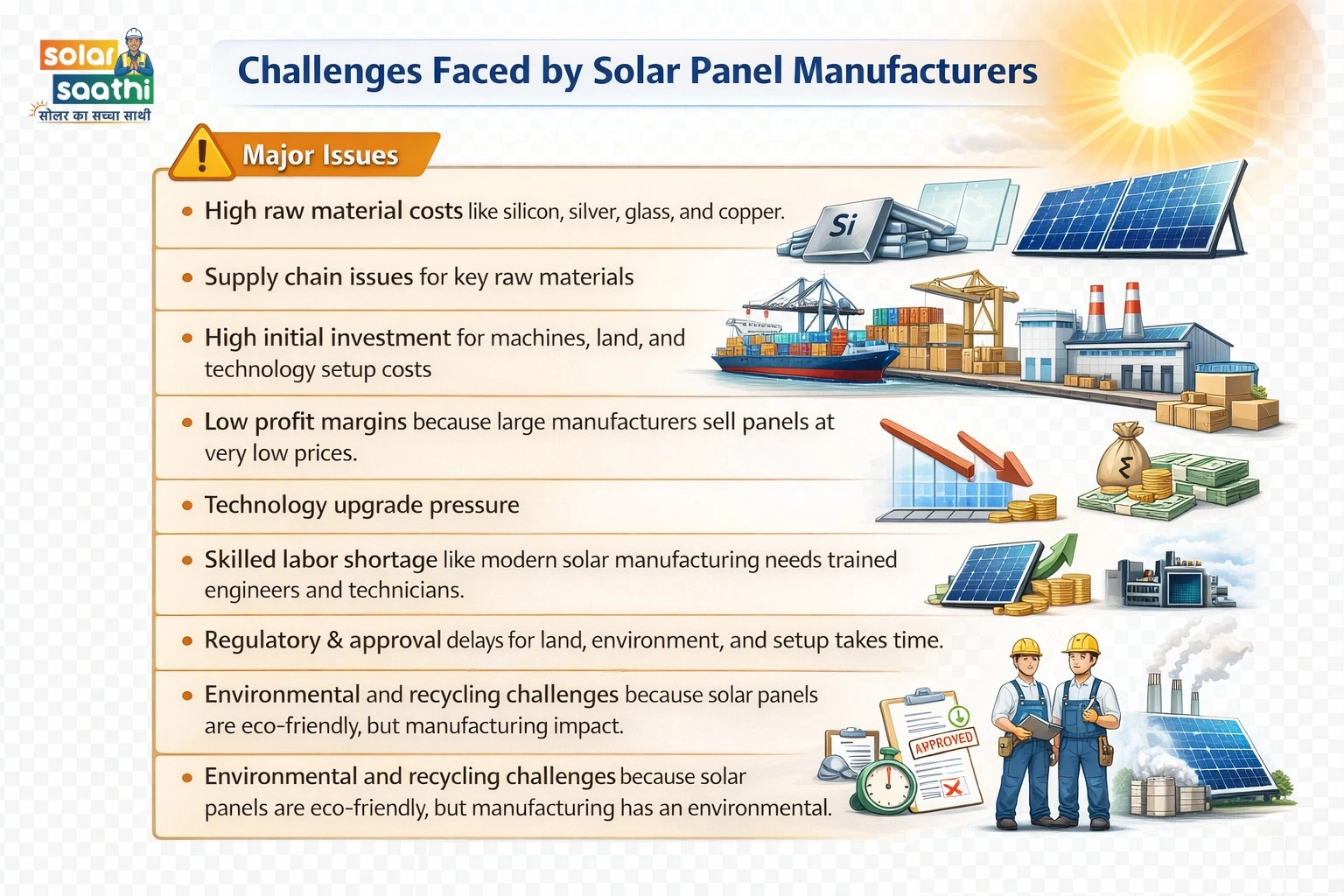
Major Issues
- High raw material costs like silicon, silver, glass, and copper
- Supply chain issues for key raw materials
- High initial investment for machines, land, and technology setup costs
- Low profit margins because large manufacturers sell panels at very low prices
- Technology upgrade pressure to stay competitive with global manufacturers
- Skilled labor shortage — modern solar manufacturing needs trained engineers and technicians
- Regulatory & approval delays for land, environment, and setup
- Environmental and recycling challenges — solar panels are eco-friendly, but manufacturing has an environmental impact
These factors impact even the major solar panel manufacturers in India. Still, the industry is improving step by step.
Future of Solar Manufacturing in India
The future of solar manufacturing in India looks very strong and promising. Demand for solar energy is increasing very fast every year. India aims to become a global hub for solar panel manufacturing. This growth will boost the solar industry in India and create new opportunities. More companies may enter the top 20 solar panel manufacturers in India list.
Key projections:
- By March 2025, solar module capacity reached around 78 GW
- Solar cell manufacturing capacity grew to nearly 25 GW
- In the next five years, module capacity may cross 150 GW
- Solar cell production may also exceed 75 GW capacity
India is moving from import dependency to strong local manufacturing. The PLI scheme is driving this transformation. In the coming years, India can become a major global solar exporter, reducing dependence on countries like China.
Choosing the right solar manufacturer becomes more important for large-scale projects — performance and ROI matter the most. If you are planning a solar setup for offices, commercial buildings, schools, hospitals, or government institutions, we provide commercial solar consultancy and institutional solar consultancy services to help you select the most reliable manufacturers and optimize system design.
Conclusion
Choosing the right manufacturer is very important. It directly affects your solar system's efficiency and long-term performance. The best Indian solar panel manufacturers combine quality materials, advanced technology, and strong after-sales support.
If you want expert help in selecting the best solar manufacturers in India, get professional solar consultancy today.
Contact now to choose the right solar solution for your needs →