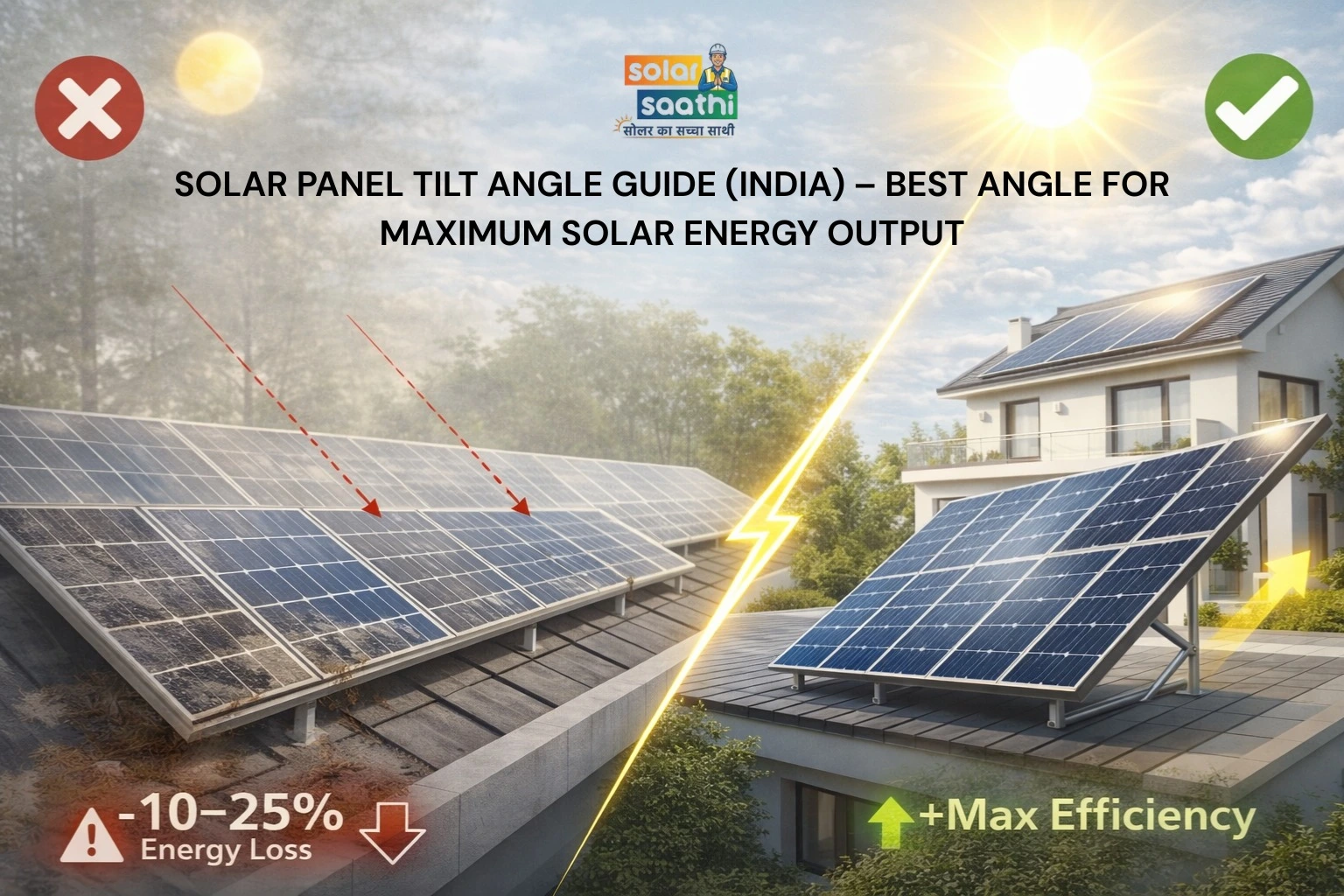
Most people think installing solar panels is simple. It just needs sunlight. Put panels on the roof and start saving money. That thinking is wrong. If your solar panel tilt angle is wrong, you lose energy daily. A bad angle can reduce efficiency by 10–25%. This means lower savings and slower ROI.
If you are new, first understand how solar energy actually works before optimizing angles.
Solar Panel Basics You Must Understand
What Is Solar Panel Tilt Angle?
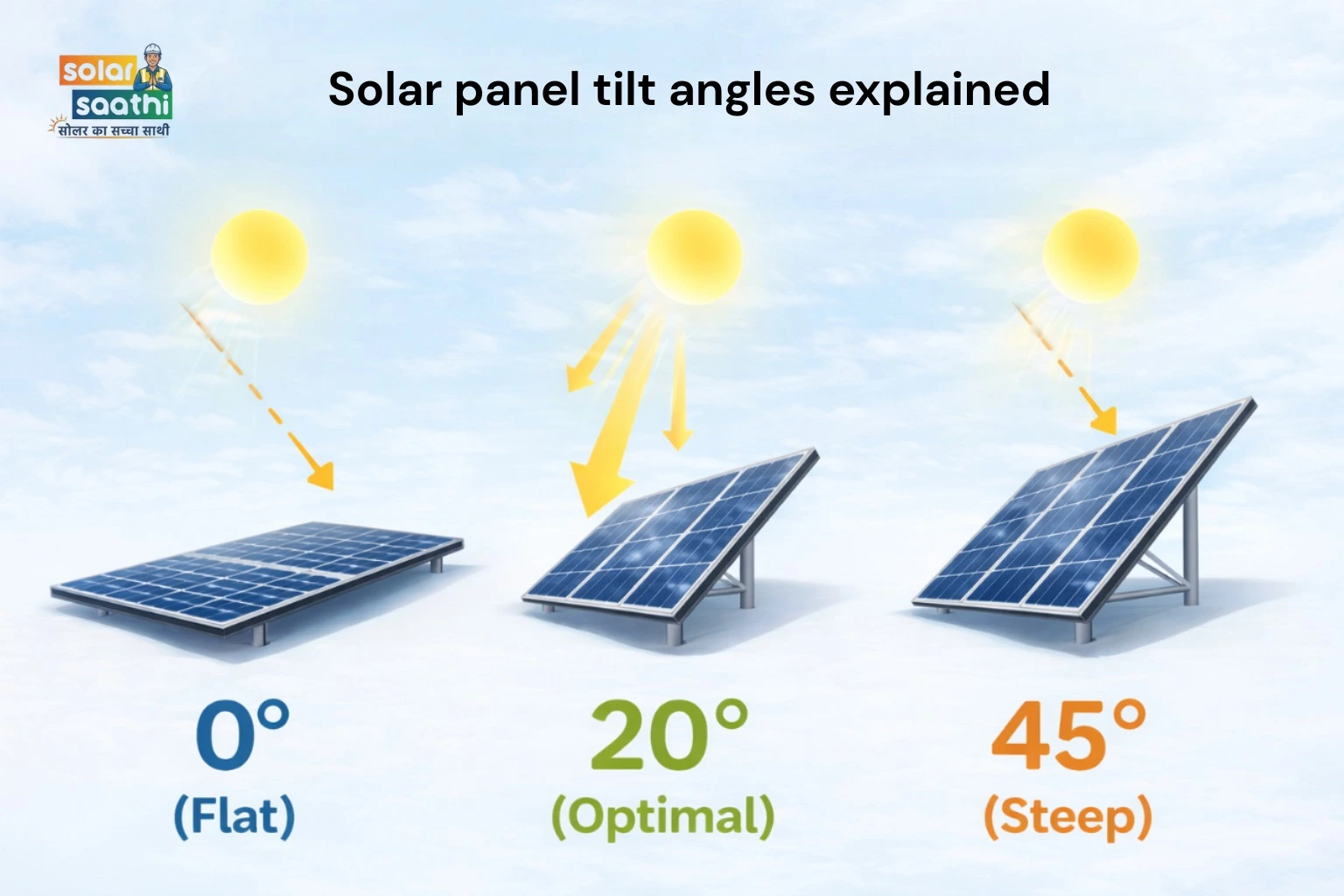
Solar panel tilt angle means the angle between the panel and the ground. Simple example:
- Flat panel = 0°
- Slight tilt = 10–30°
- Steep tilt = 40°+
If your panel lies flat → angle = 0°. If it is fully vertical → angle = 90°. This angle decides how much sunlight hits the panel. Most solar systems use angles between 10° to 30° in India.
What Is Solar Panel Orientation?
Orientation means the direction your panel faces. Examples:
- Facing South → Maximum sunlight in India
- Facing East → Good for morning usage
- Facing West → Good for evening usage
So, tilt = angle, orientation = direction. Why? Because the sun stays mostly in the southern sky.
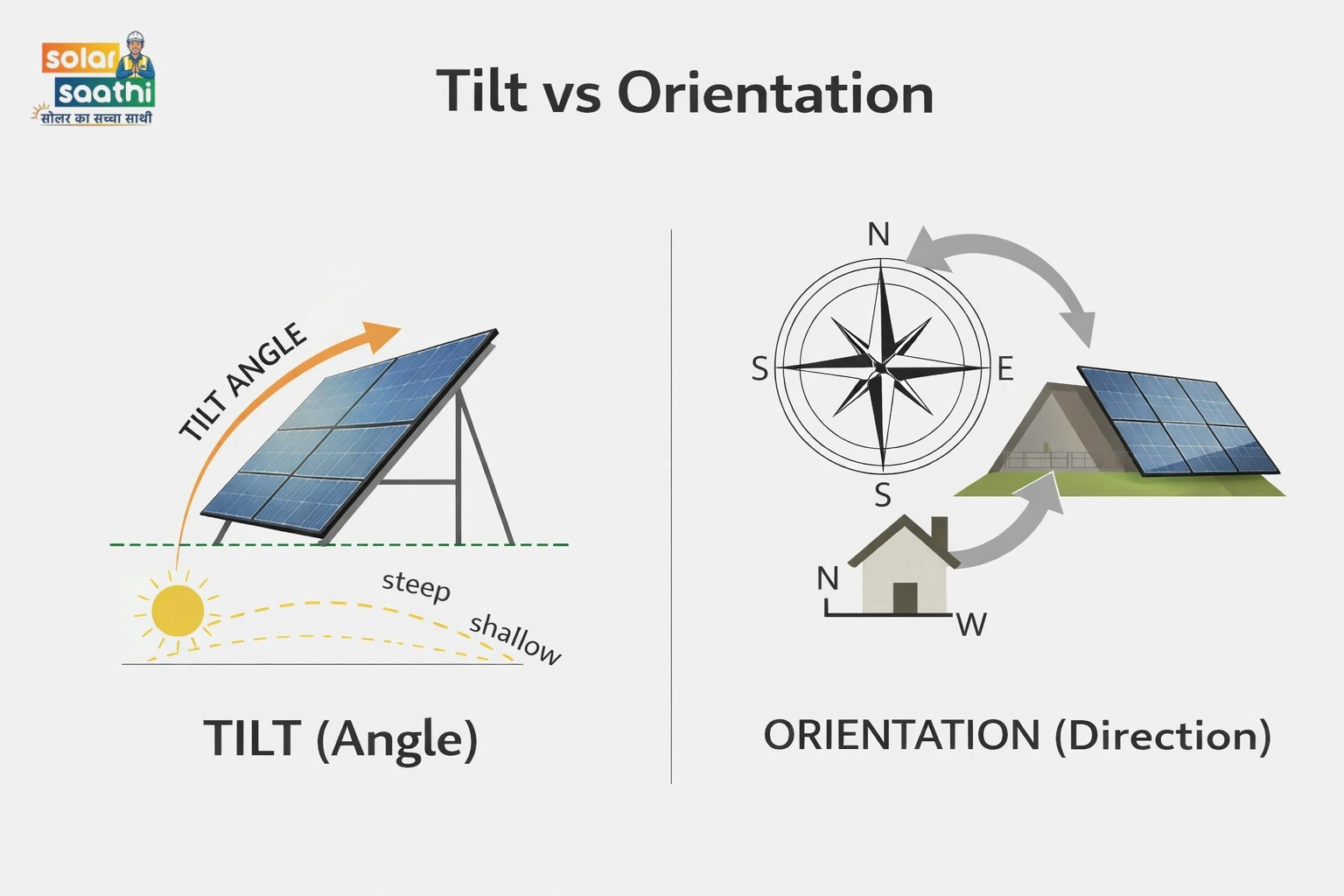
Tilt vs Orientation
- Tilt = angle of panel
- Orientation = direction of panel
Keep this simple:
- Tilt decides how much sunlight hits the panel
- Direction decides when sunlight hits the panel
Both matter. Ignore either, and performance drops. Both must be correct for maximum output. Not sure what is the best tilt angle for solar panels in your location? Check it using our solar panel angle calculator.
The Science Behind Solar Panel Tilt
How Sunlight Angle Affects Energy Output
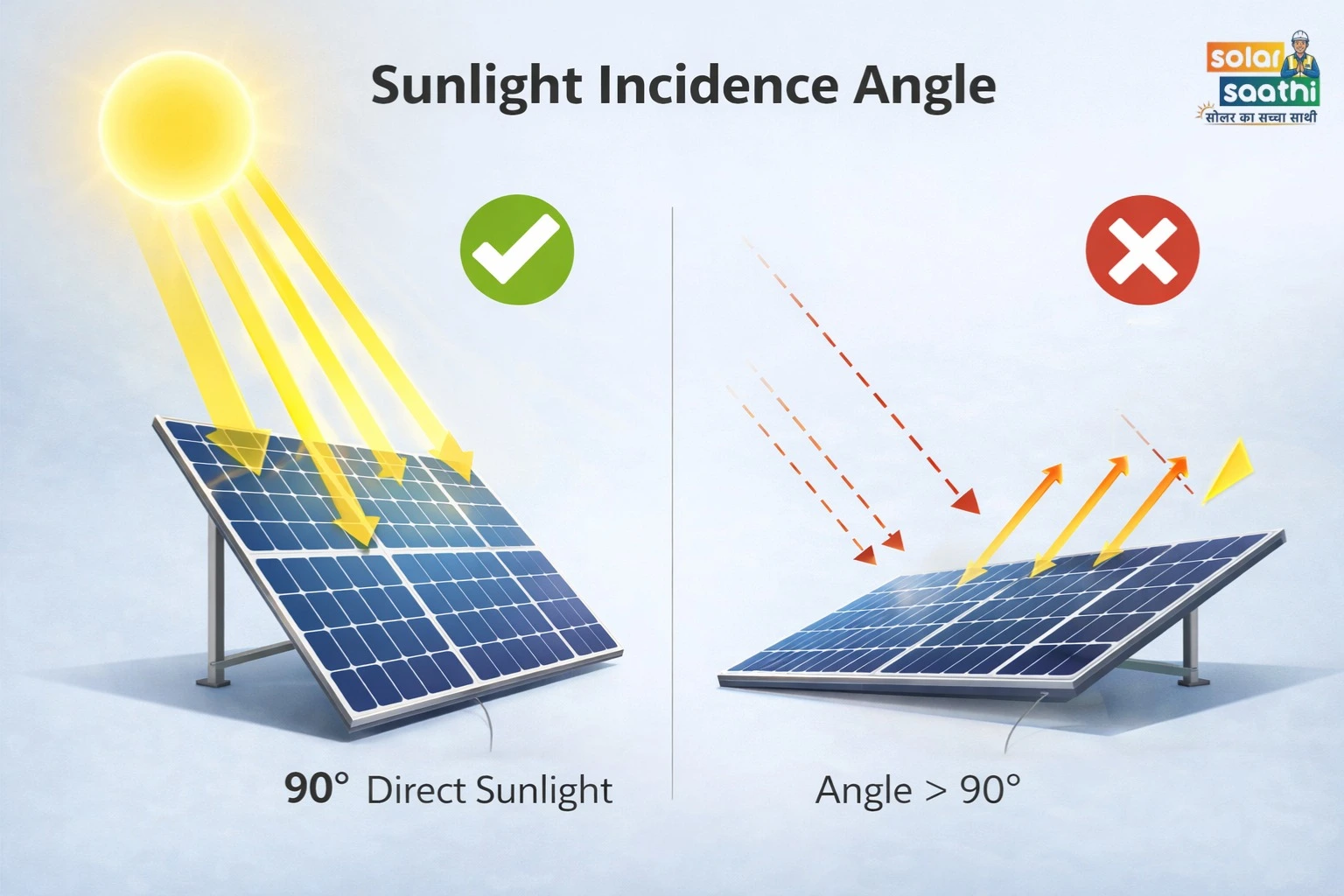
Solar panels work best when sunlight hits them directly.
If sunlight hits at an angle:
- Some energy reflects away
- The output drops instantly
This is called incidence loss. This is why the ideal solar panel angle is important.
Why Solar Panels Are Not Installed Flat
Flat panels look easy. But they are inefficient. Problems with flat panels:
- Dust accumulation
- Water stagnation
- Lower sunlight absorption
Tilt solves all three problems and improves both performance and cleaning.
Concept of Solar Incidence Angle
The incidence angle is the angle between sunlight and the panel surface.
- A smaller angle = better performance
- A higher angle equals more reflection loss
This is why the best angle for solar panels is not random. It is calculated.
Why the Correct Tilt & Angle Is Important
Maximizes Solar Energy Output
A correct solar panel angle ensures maximum capture of sunlight daily. More sunlight = more electricity.
Reduces Reflection & Energy Loss
A wrong angle reflects sunlight away. Correct tilt reduces this loss and absorbs maximum radiation.
Improves Self-Cleaning & Maintenance
Tilt allows:
- Rain to wash dust off panels
- Dirt to slide off
Flat panels need manual cleaning.
Optimizes ROI & System Efficiency
This is where most people fail. Bad angle = lower generation. Lower generation = longer payback. You don't lose once. You lose every single day.
Even a 5% gain matters over 25 years.
Best Solar Panel Angle in India (Region-Wise)
India has different latitudes. So angles change.
Southern India Tilt
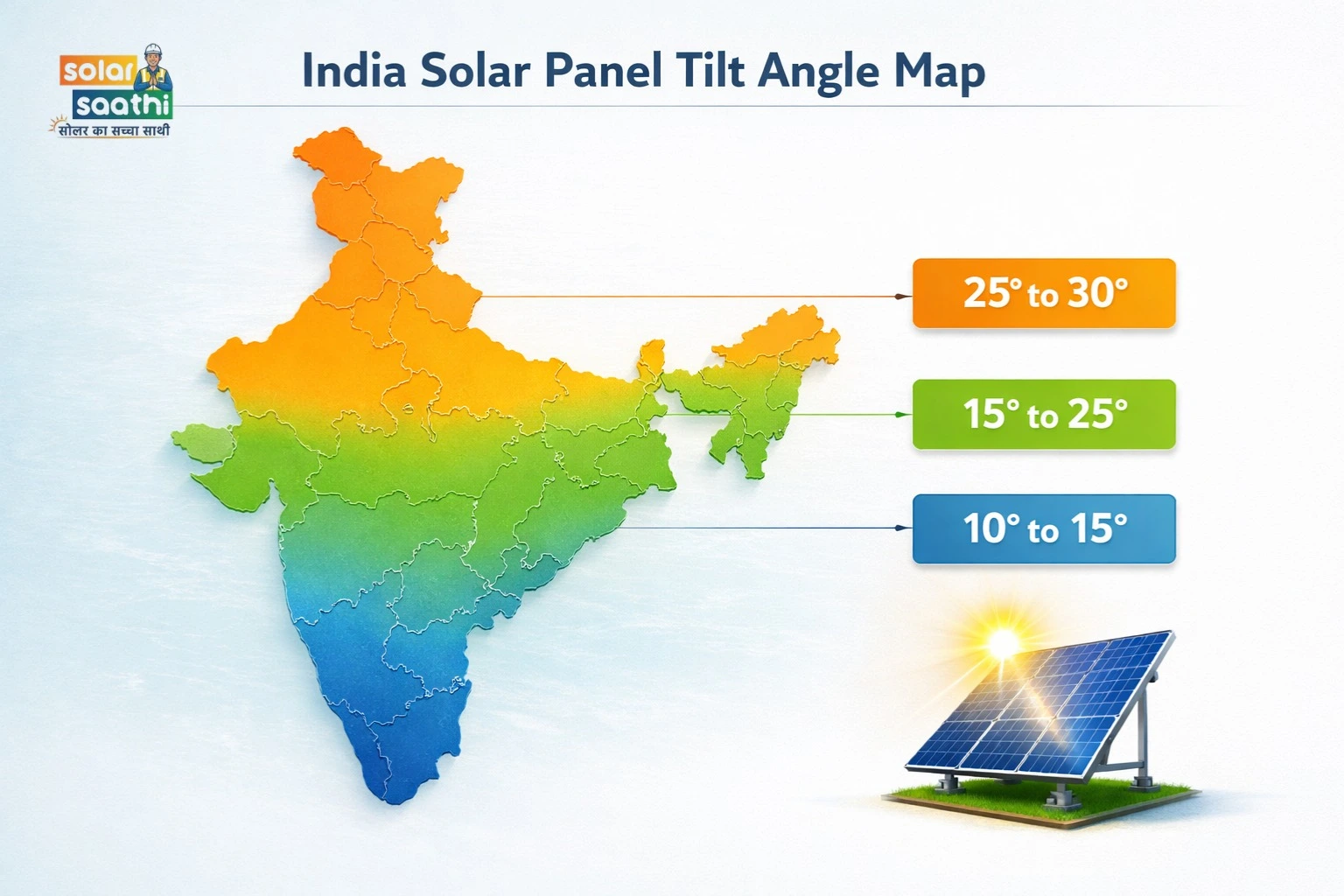
States like Tamil Nadu, Kerala, and Karnataka. Suggested solar tilt:
- 10° to 15°
The sun is more overhead here.
Central India Tilt
States like Maharashtra, MP, and Telangana. Recommended tilt:
- 15° to 25°
Balanced sunlight throughout the year.
Northern India Tilt
States like Rajasthan, Delhi, and Punjab. Recommended tilt:
- 25° to 30°
Sun angle is lower. So tilt increases. A steeper angle helps in winter.
Ideal Direction: Why South-Facing Works Best
In India, the best direction for solar panels is south. Why?
- The sun travels slightly south of overhead
- South-facing panels get maximum exposure
If not possible, South-East or South-West is acceptable. Avoid North-facing panels.
Other options:
- East → morning benefit
- West → evening benefit
But overall, solar panel direction in India — South is the best.
Practical Installation Factors That Affect Tilt
Roof Design & Structure
Your roof decides what is possible.
- Flat roof → flexible tilt
- Sloped roof → fixed direction
Many systems compromise here.
Available Space & Shadow Analysis
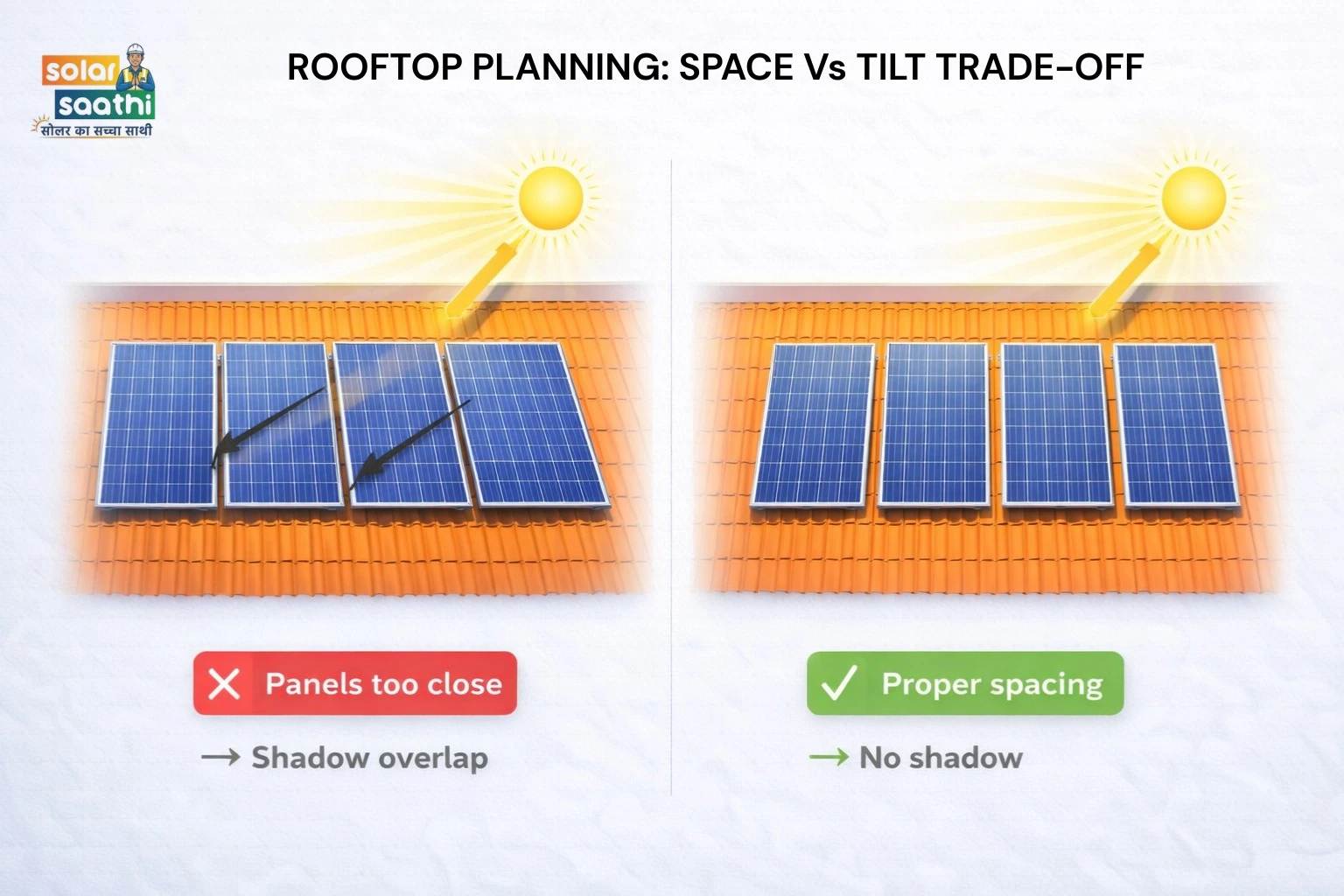
More tilt = more spacing needed. Less spacing = shadow issues. This is where most installers make mistakes. A professional solar site assessment ensures your panels get maximum sunlight.
Weather Conditions (Dust, Rain, Wind)
- Dust-heavy areas need more tilt
- Wind-heavy zones need strong mounting
- Rain helps cleaning, but tilt still matters
Geographic Location Factor
Your geographic location directly affects the panel tilt angle. Higher latitudes need steeper angles. Lower latitudes work better with flatter positions. This helps panels capture maximum sunlight throughout the year.
Purpose of Installation (Residential vs Commercial)
- Residential: Space limited, optimization needed
- Commercial: Larger area, design flexibility
Your use case changes your angle.
Rooftop Planning: Space vs Tilt Trade-Off
Flat vs Steep Tilt Impact on Space
Higher tilt = better efficiency, but it reduces how many panels you can install. Lower tilt = more panels, but slightly less efficiency. So what matters more? — Total output, not individual panel efficiency.
Row Spacing & Shadow Avoidance
Panels cast shadows on each other. Improper spacing leads to the following:
- Output drop
- System inefficiency
Professional design avoids this.
Types of Solar Mounting Systems
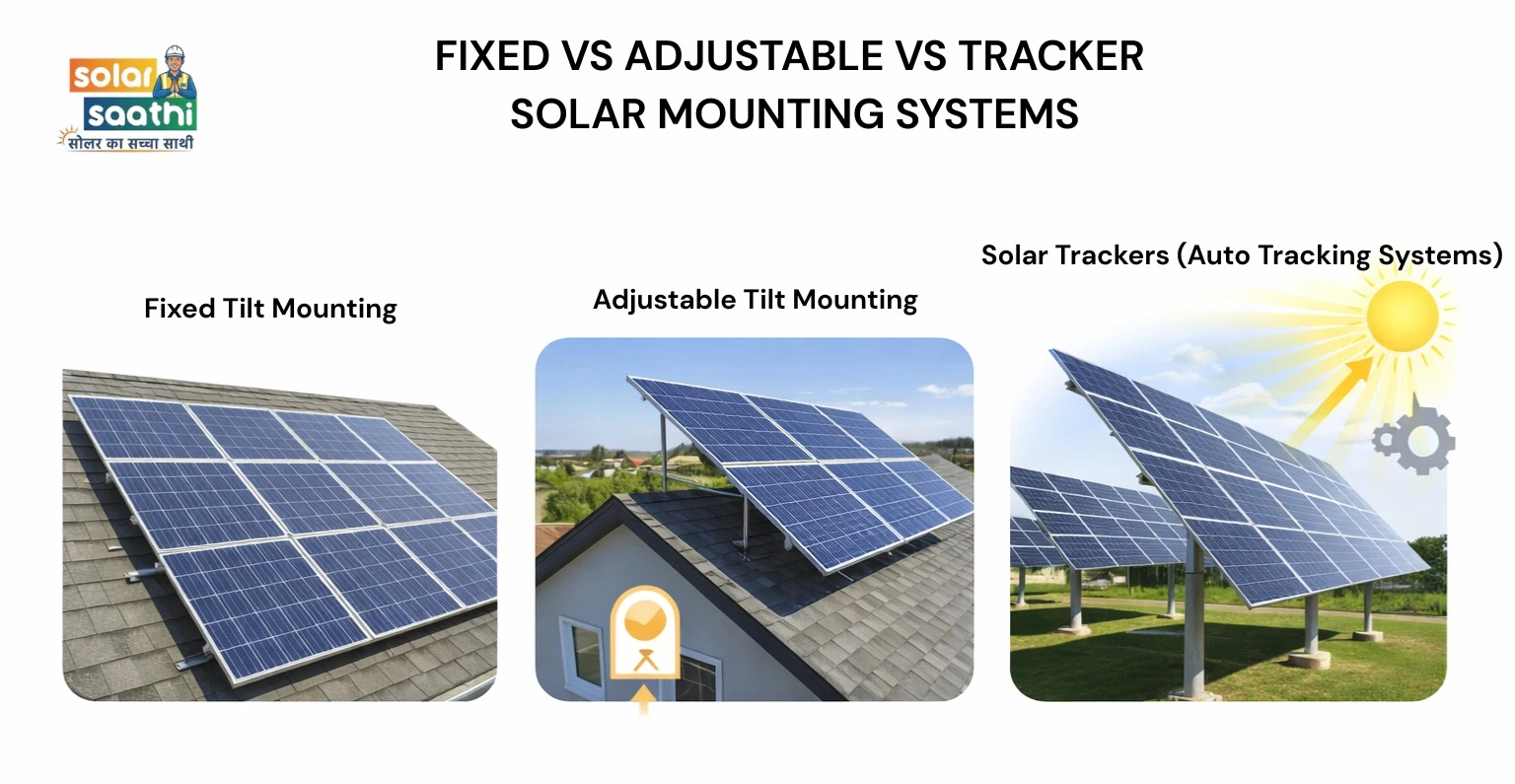
Fixed Tilt Mounting
In this system, solar panels are installed at one fixed angle. The angle does not change throughout the year.
It is the most common option for homeowners. The setup is simple and requires low maintenance. Because of its low cost and reliability, it works well for most residential rooftops.
However, choosing the right tilt for your home is not always simple. Roof direction, space, and sunlight exposure all matter. A residential solar planning service helps you design the right setup for maximum output.
Adjustable Tilt Mounting
This system allows you to change the panel angle manually. You can adjust it based on seasons for better sunlight usage. By optimizing the angle during the year, energy generation improves. In many cases, it can increase output by around 5% to 15%.
This type is more practical for ground-mounted systems or larger installations.
Solar Trackers (Auto Tracking Systems)
Panels follow the sun automatically all day.
Pros:
- Higher energy generation
- Better efficiency than fixed systems
Cons:
- Expensive setup
- Requires regular maintenance
- Not suitable for small rooftops
This system can increase efficiency by around 25% to 35%. Because of the high cost and upkeep, it is mostly used in large solar farms rather than residential homes.
Solar Panel Losses You Must Understand
Tilt & Orientation Loss
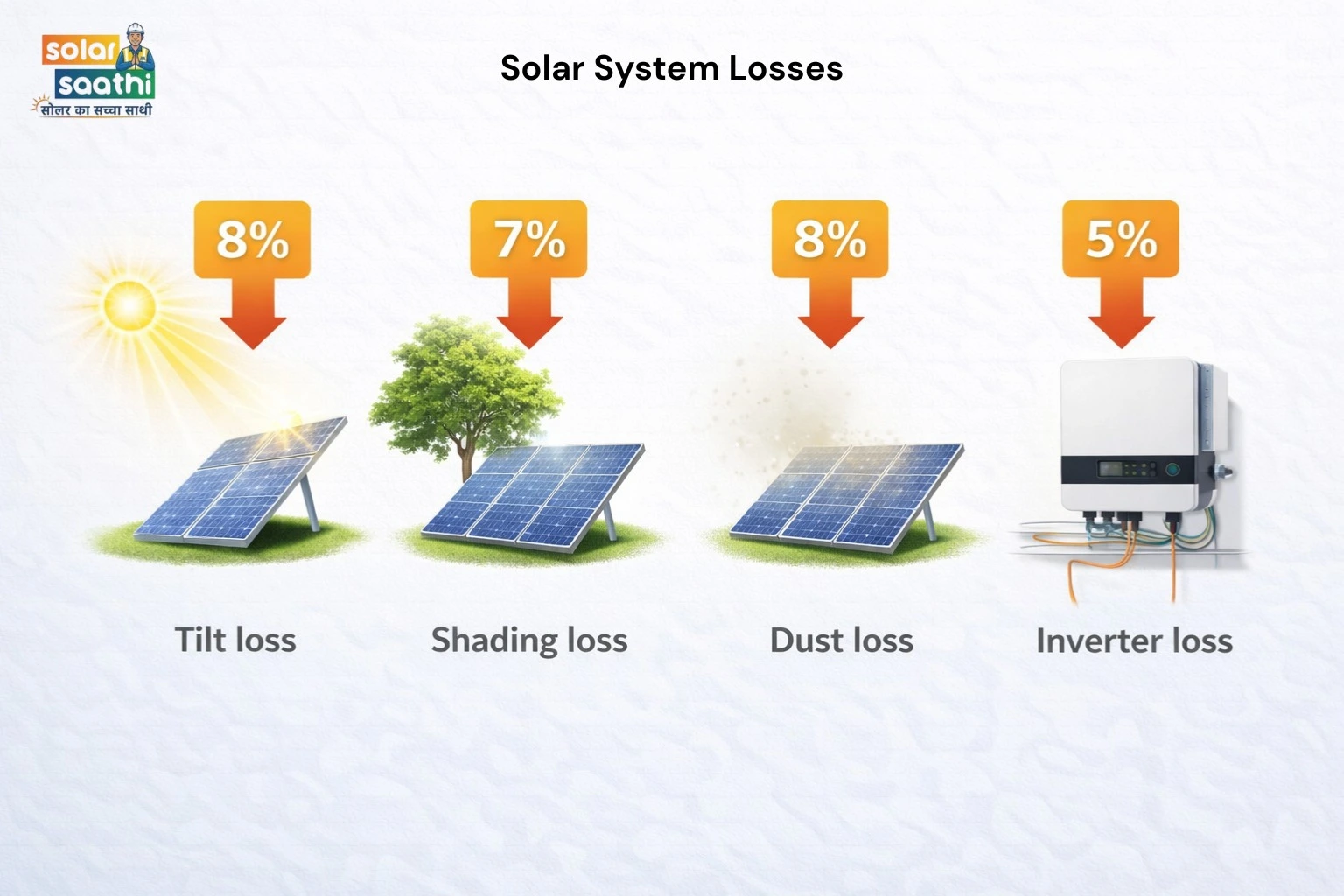
Wrong angle = lower sunlight capture. The wrong solar panel direction and angle in India cause direct losses. This is the biggest hidden problem.
Incident Angle Loss (IAM)
Light entering at an angle reduces efficiency. Typical loss: 2–4%. Even small angle errors matter.
Shading & Mismatch Loss
One shadow can reduce full system output. Partial shade = huge loss. One panel under shade affects the entire string.
Temperature Loss (Heat Impact)
High heat reduces panel efficiency. Panels work best when slightly cool.
Dust, Dirt & Environmental Loss
Dust blocks sunlight. Common in Indian cities. Tilt helps reduce this.
Inverter & Electrical Losses
Your solar panels generate DC power. Your home uses AC power. The inverter converts DC → AC. And this is where losses start.
Inverter Efficiency Loss
No inverter is perfect. Typical efficiency = 95% to 98%. That means:
- If panels produce 100 units
- You actually get only 95–98 units
- 2–5% energy is always lost during conversion
During conversion: heat is generated and internal electronics consume energy. You cannot eliminate this loss. You can only minimize it by choosing a good inverter.
What Is Inverter Clipping?
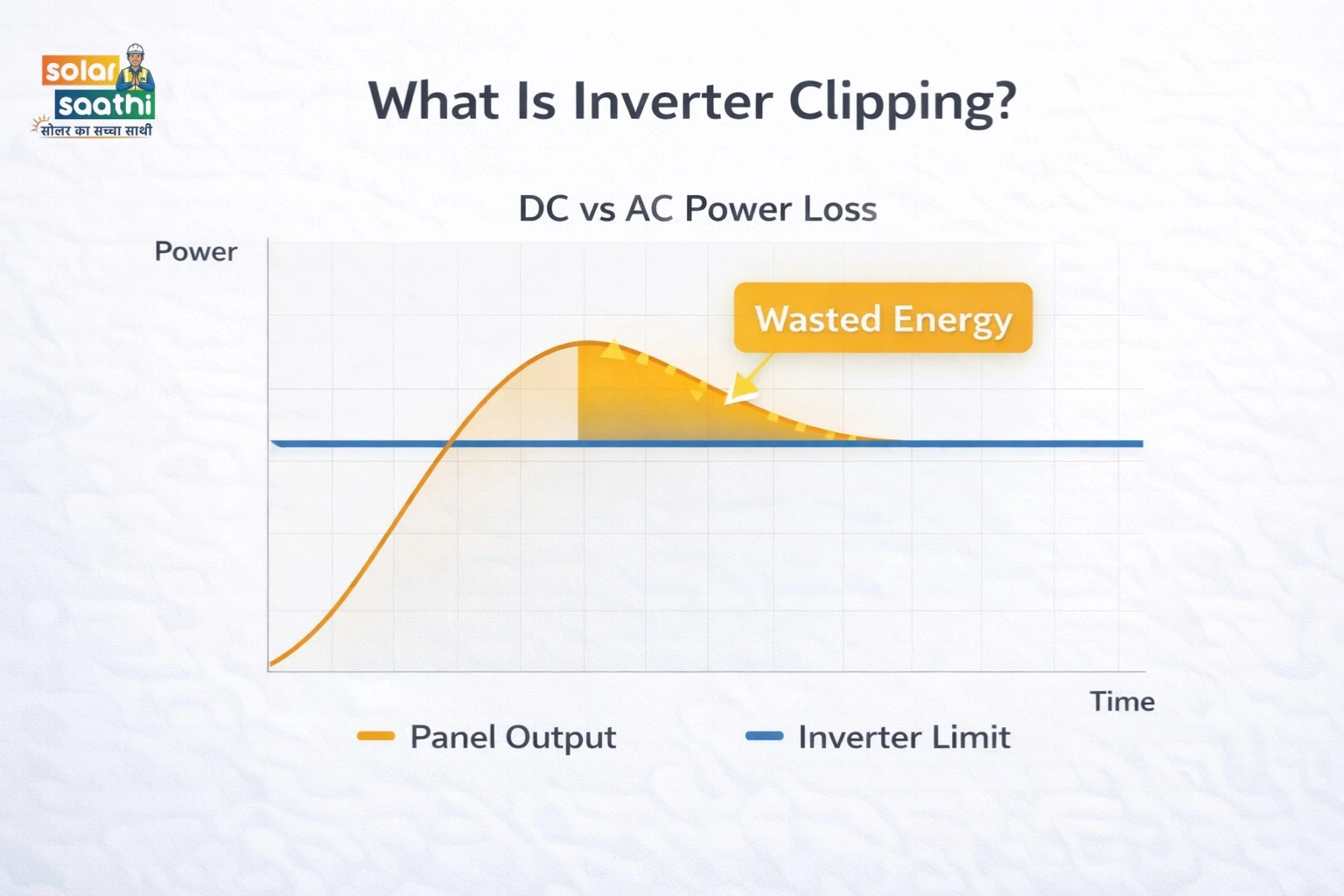
This is where real damage happens. Your solar panels produce more power than your inverter can handle. Excess energy gets wasted.
Example:
- Panel capacity = 5 kW
- Inverter capacity = 4 kW
Now:
- Panels produce 5 kW (peak sunlight)
- The inverter can only process 4 kW
An extra 1 kW is wasted. This is called clipping.
DC-to-AC Ratio Explained
This ratio defines how much panel capacity (DC) vs inverter capacity (AC).
Formula: DC-to-AC Ratio = Total Panel Capacity ÷ Inverter Capacity
Example: Panels = 6 kW, Inverter = 5 kW → Ratio = 1.2
This ratio balances system performance. Wrong ratio = loss or wasted investment.
Ideal DC-to-AC Ratio
In India, the best range is 1.1 to 1.3. Why not 1:1? Because:
- Panels rarely produce full capacity
- Heat reduces output
- Dust reduces efficiency
So slightly oversizing panels makes sense.
How to Reduce Solar System Losses
Correct Tilt & Orientation Setup
This is the first step in improving performance. Even a small mistake in angle reduces output daily. Fix this once → benefits last for 25+ years.
Shadow Management Techniques
Shading is one of the biggest hidden losses. Avoid these mistakes:
- Keep panels away from trees
- Maintain proper row spacing
- Follow a planned rooftop layout
Even partial shadow can reduce system output drastically.
Better Component Selection
Cheap components look attractive at first. But they fail faster and reduce efficiency. Always choose reliable panels and inverters. Long-term performance matters more than short-term savings.
Proper System Design & Spacing
This is where most systems fail silently. People focus on panels and price. But ignore design and layout planning. Bad design leads to:
- Energy losses
- Poor spacing
- Shadow issues
Most solar failures happen due to poor execution or poor equipment. A solar installer selection consultancy service helps avoid wrong vendors who ignore design and system efficiency.
Common Mistakes in Solar Panel Angle & Installation
Here's the truth most installers won't tell you:
- Using flat installation to save cost
- Ignoring shadow analysis
- Overcrowding panels
- Wrong direction due to roof shape
- No proper design calculation
These mistakes reduce system performance permanently.
Practical Checklist Before Installing Solar Panels
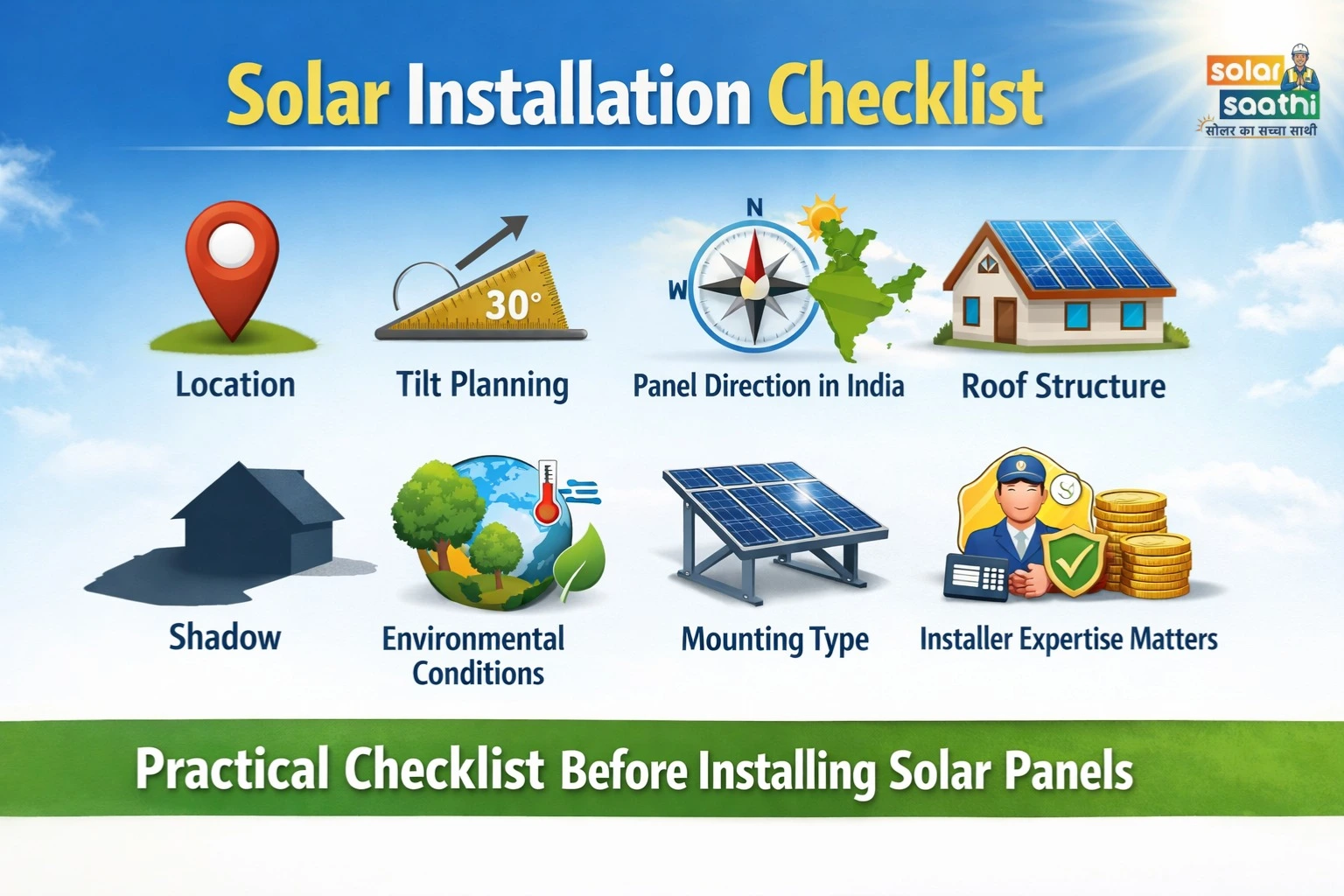
Before installing, don't rush into decisions. A few checks can save years of energy loss.
Location & Tilt Planning
Start with your location's latitude. This gives a base for the ideal solar panel angle. Adjust the tilt slightly based on usage and roof type. This ensures better yearly output.
Solar Panel Direction in India
Check your roof direction carefully. The best direction for solar panels in India is south-facing. If not perfectly south, don't panic. Small deviations still work with minor output loss.
Roof Structure & Mounting Possibility
Understand your roof slope and structure. Not all roofs allow the perfect solar panel angle. You may need mounting structures to adjust tilt. This impacts both cost and performance.
Shadow & Space Analysis
Look for trees, tanks, or nearby buildings. Even small shadows reduce output significantly. Also check row spacing between panels. Proper spacing avoids self-shadowing issues.
Weather & Environmental Conditions
Dust, rain, and wind affect system performance. Higher tilt helps in dusty areas for self-cleaning. Strong winds may require better mounting support.
Budget & Mounting Type
Choose between fixed or adjustable tilt systems. Fixed systems are cost-effective and widely used. Adjustable systems give slightly better output. But they increase cost and complexity.
Installer Expertise Matters
Most performance issues come from poor execution. Not from panel quality. Choosing the right installer ensures proper solar panel direction and angle in India.
Key Takeaways for Homeowners & Solar Businesses
Most failures happen due to poor planning, not bad panels. Let's simplify everything into actionable points.
For Homeowners
- Solar panel angle directly affects your electricity savings
- South-facing panels give best output in India
- Use latitude as the base tilt angle
- Avoid shading at all costs
- Never install panels flat
- One wrong decision can reduce ROI for decades
For Solar Installers / EPC Companies
- Always design systems based on location data
- Use solar software for accurate estimation
- Optimize tilt and spacing together
- Avoid mixing shaded and non-shaded panels
- Educate customers on angle and losses
- Better design = better trust = more referrals
Conclusion
Solar is a long-term investment. One wrong decision today affects 25 years of performance. Don't rely on guesswork. Don't blindly trust vendors. Get your system designed properly.
Want a high-performance solar system? Start with a professional solar consultancy before installation.
FAQs
1. What is the tilt angle for solar panels in India?
The solar panel tilt angle in India usually ranges between 10° to 30°. It depends on your location. Key regional suggestions:
- Southern India (e.g., Tamil Nadu, Kerala, Karnataka): ~10° to 15° tilt
- Central India (e.g., Maharashtra, MP, Gujarat): ~15° to 25° tilt
- Northern India (e.g., Delhi, Punjab, UP): ~25° to 35° tilt
2. What effect does tilt angle have on solar panels?
The solar panel tilt angle directly affects how much sunlight your panels receive. More direct sunlight means more electricity. The ideal solar panel angle allows sunlight to hit the panel straight. A wrong angle causes reflection loss and reduces system efficiency.
3. What is the best tilt angle for solar panels?
The best angle for solar panels depends on your location. There is no one fixed number. In India, the ideal solar panel angle is usually close to your latitude. Small adjustments based on roof and usage improve yearly output.
4. Why is the tilt angle important?
The solar panel tilt angle controls how much energy your system generates. It directly affects savings and performance. A correct solar panel angle reduces losses, improves self-cleaning, and increases ROI over 25+ years.
5. What is the relationship between tilt and seasons?
The solar panel angle changes with seasons because the sun's position shifts during the year. In summer, a lower tilt works better. In winter, a higher tilt captures more sunlight. Adjusting the ideal solar panel angle seasonally improves output.
6. How do I calculate the ideal solar panel angle for my home?
Start with your location's latitude. This gives you a base ideal solar panel angle. Then adjust based on roof design, shading, and energy needs. This helps optimize solar panel direction and angle in India for better efficiency.
7. Which direction should solar panels face in India?
The best direction for solar panels in India is south-facing. This gives maximum sunlight the entire day. The solar panel direction in India works best this way because the sun stays mostly in the southern sky.
8. Can solar panels face east or west in India?
Yes, solar panels can face east or west. But output changes based on direction. East-facing panels work better in the morning. West-facing panels perform better in the evening. Still, they produce less energy than the best solar panel direction in India (south-facing).
9. What happens if the solar panel tilt angle is wrong?
A wrong solar panel tilt angle reduces system performance. It can cut efficiency by 10–25%. The wrong solar panel direction India setup also adds to losses. This leads to lower generation, higher costs, and slower ROI.
10. Is it okay to install solar panels flat on the roof?
No, flat installation is not a good option. It reduces system efficiency. Without the correct solar panel angle, dust and water build up. Sunlight absorption also drops. Proper tilt improves both performance and cleaning.
11. What is the difference between solar panel tilt and orientation?
"Tilt" means the solar panel's angle relative to the ground. "Orientation" means the solar panel face direction in India. Both work together. Correct solar panel direction and angle in India ensures maximum energy output.
12. Does solar panel angle change in different parts of India?
Yes, the solar panel orientation in India and tilt angle change by region. This happens due to latitude differences. That's why the ideal solar panel angle is not the same across India.
13. How much energy loss occurs due to wrong solar panel direction?
If the direction of the solar panel in India is not correct, energy loss can be high. It usually ranges from 5% to 20%. Correct solar panel direction India setup ensures better performance and higher efficiency.
14. Do I need a professional to set the solar panel angle correctly?
Yes, professional help makes a big difference. Experts analyze roof, shadow, and location. They decide the best solar panel direction and angle in India. This ensures maximum output and faster ROI.