Are you planning to switch to clean energy for your home? Going solar is now easier and cheaper than ever before. If you have a small home or a low electricity bill, a 1kW setup can be a useful option. Understanding the 1kW solar panel price with subsidy helps you plan your budget. Government schemes can make rooftop solar more affordable for eligible households.
What Is a 1kW Solar Panel System?
A 1kW (1,000-watt) solar system is a compact renewable-energy setup that generates electricity from sunlight. It typically includes:
- Solar panels
- A grid-tied or hybrid inverter
- Mounting structures
- DC and AC cables
- Safety equipment, such as surge protection devices and earthing kits
The system can supply electricity to your home through the grid-connected setup or, where configured, store energy in batteries.
How Many Solar Panels Are Needed for 1kW?
The number of panels depends on the wattage of each panel. With panels rated around 400W–500W, a 1kW setup generally needs about two or three panels. For example, two 500W panels provide 1,000W of rated capacity. Modern Mono PERC and TOPCon panels can offer higher output in a relatively compact rooftop area.
1kW Solar Panel Price in India in 2026
What Does a Complete Solar System Price Include?
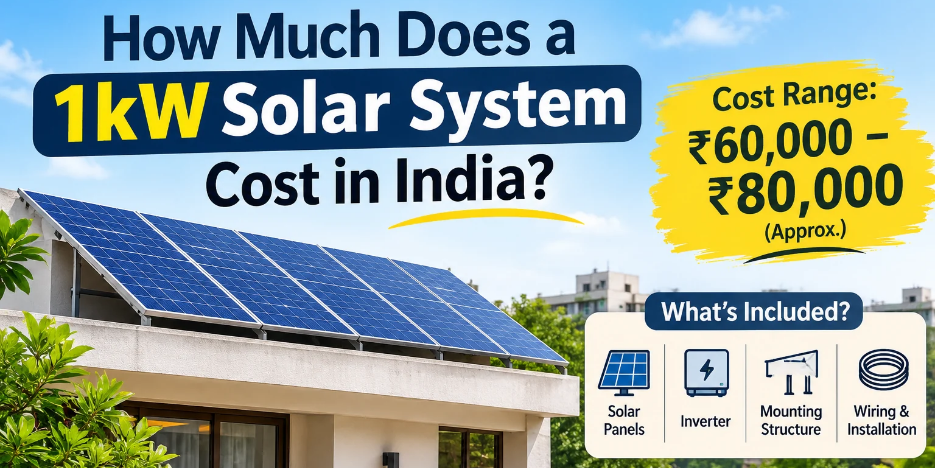
When you pay for a complete 1kW solar panel setup, you are paying for more than the panels. A turnkey package may include:
- Solar photovoltaic panels: Mono PERC or bifacial modules; subsidy eligibility may require DCR-compliant panels.
- Inverter: Converts the DC electricity generated by the panels into usable AC electricity.
- Mounting structures: Galvanized iron (GI) or aluminium structures designed for local wind conditions.
- Balance of system (BOS): AC/DC distribution boxes, DC cables, earthing kits, and surge protection devices (SPDs).
- Installation and documentation: Installation labour and, where included, net-metering applications and DISCOM coordination.
Related reading: Solar Panel Price in India
Why Do Solar Quotes Vary?
Quotes for a Tata Solar Panel 1kW system or other Tier-1 brands can vary because of:
- Brand and product quality: Premium brands may charge more for product quality, warranties, and efficiency.
- Structure type: Standard fixed-tilt structures are generally less expensive than elevated structures.
- Component add-ons: Lightning arrestors, monitoring apps, and customised wiring can affect the total.
1kW Solar System Installation Cost Breakdown
| Parameter | Approximate details |
|---|---|
| Standard system cost before subsidy | ₹55,000–₹70,000 |
| Premium system cost before subsidy | ₹70,000–₹85,000 |
| PM Surya Ghar subsidy stated in the source | ₹30,000 |
| Estimated net cost after subsidy | ₹25,000–₹45,000 |
| Daily electricity generation | 4–5 units/day |
| Monthly electricity generation | 120–150 units/month |
| Annual electricity generation | 1,400–1,800 units/year |
| Estimated monthly bill savings | ₹800–₹1,200 |
| Approximate shadow-free roof space | 80–100 sq. ft. |
| Typical payback period | 4–6 years |
| Number of 400W panels | About 2–3 |
| Suitable use cases | Small homes, small shops, and light rural loads |
Related reading: 3 Kilowatt Solar Panel Price in India
1kW Solar Panel Price After Subsidy
The supplied article estimates that subtracting a ₹30,000 central subsidy from a standard system cost results in an effective out-of-pocket cost of around ₹25,000–₹45,000. Actual pricing and subsidy eligibility depend on the applicable scheme rules, installation configuration, and approved vendor process. Confirm the current terms on the official PM Surya Ghar portal before making a purchase.
Major Factors Affecting the 1kW Solar Panel Price
Type of Solar Panels
- Polycrystalline panels: Older technology, usually less expensive upfront but generally less efficient.
- Monocrystalline, Mono PERC, and TOPCon panels: Higher-efficiency options commonly used in modern installations.
- Bifacial panels: Can capture sunlight from both sides and may be useful on suitable elevated structures; they can cost more.
System Configuration: On-Grid, Off-Grid, or Hybrid
The total investment depends significantly on whether the system is grid-connected or includes battery storage.
Battery Storage and Inverter Types
| Solar system type | Approximate price stated in the source | Subsidy stated in the source |
|---|---|---|
| 1kW on-grid solar system | ₹55,000–₹70,000 | ₹30,000 |
| 1kW off-grid solar system | ₹1,90,000–₹2,10,000 | Not applicable |
| 1kW hybrid solar system | ₹1,60,000–₹1,80,000 | Not applicable |
| 1kW solar panels only | ₹45,000–₹55,000 | Not applicable |
Note: The source estimates that a 1kW solar panel setup with batteries costs more upfront because it includes storage batteries. Subsidy treatment depends on the scheme rules and system configuration.
Solar Subsidy on a 1kW System: PM Surya Ghar Yojana
The source describes the PM Surya Ghar: Muft Bijli Yojana as a central government initiative supporting rooftop solar adoption. It states a ₹30,000 subsidy for a 1kW setup. Since scheme amounts and eligibility can change, verify the latest rules through the official PM Surya Ghar portal before applying.
PM Surya Ghar Eligibility Criteria
The supplied article lists these conditions:
- The applicant must be an Indian citizen and have a suitable residential rooftop.
- The electricity connection must be registered in the applicant's name.
- The system must be grid-connected (on-grid) and use net metering.
- Installation must be completed by an authorised vendor and use approved DCR panels.
Check the current official scheme guidelines to confirm all eligibility conditions.
Required Documents
The source lists the following documents:
- Latest electricity bill
- Identity proof, such as Aadhaar Card, Voter ID, or Passport
- Property ownership proof, such as a tax receipt, registry, or allotment letter
- Passport-size photograph and cancelled cheque or bank proof for subsidy transfer
- Mobile number linked with Aadhaar
How to Apply for the Subsidy
- Register on the national portal: Use your state electricity distribution company (DISCOM) consumer-account details.
- Select a registered vendor: Ask an approved vendor to assess your site and provide a quotation.
- Obtain feasibility approval: The local DISCOM reviews the application for technical feasibility and net metering.
- Install the system: Have the authorised vendor install the system according to applicable safety requirements.
- Complete inspection and commissioning: The DISCOM inspects the installation and handles the bidirectional net meter process.
- Submit commissioning documents: Follow the portal's process for subsidy disbursement and verify the expected timeline through official guidance.
How Much Electricity Does a 1kW Solar System Generate?
Under favourable weather conditions, the supplied article estimates generation of approximately:
- Daily: 4–5 units (kWh)
- Monthly: 120–150 units
- Annually: 1,400–1,800 units
Actual output varies with location, sunlight, shade, panel orientation, weather, and system losses.
What Can a 1kW Solar System Run?
Depending on appliance wattage and simultaneous usage, a 1kW system may support essential household loads such as:
- 3–4 ceiling fans
- 6–8 LED lights or tube lights
- One television and set-top box
- One single-door, direct-cool refrigerator
- Mobile phones and laptop charging
These are indicative examples, not a guarantee that all appliances can run simultaneously. A 1kW system may be unsuitable for heavy loads such as a 1.5-ton air conditioner or a water heater (geyser).
Does a 1kW Solar System Work During a Power Cut?
- On-grid systems: Typically shut down during a grid outage for anti-islanding safety, so they do not provide backup power on their own.
- Off-grid and suitable hybrid systems: Can supply selected loads from stored battery power, depending on battery capacity and system design.
If backup power is important, compare the total cost of a battery-backed setup before choosing a system.
Return on Investment and Payback Period
The source estimates monthly electricity savings of ₹800–₹1,200 and a post-subsidy investment of ₹25,000–₹45,000, with a typical payback period of 4–6 years. Your actual savings and payback depend on electricity tariffs, consumption patterns, system output, maintenance, and the subsidy you actually receive.
The supplied article also notes that solar panels may carry a 25-year performance warranty. Review the specific warranty documents supplied with your chosen panels and inverter.
Example: A Small Home in Rohini, Delhi
Consider a small 1 BHK home in Rohini, Delhi, consuming around 130 units per month and receiving a bi-monthly electricity bill of roughly ₹2,000.
The source gives this illustrative example:
- A standard on-grid 1kW system costs ₹60,000 before subsidy.
- A ₹30,000 subsidy would bring the estimated net cost to ₹30,000.
- If the system offsets nearly 125 units per month, the household could substantially reduce its electricity bill.
This is an illustrative scenario; actual bill reductions and payback depend on local tariffs, generation, consumption, and scheme eligibility.
Who Should Choose a 1kW System?
Advantages
- Lower initial cost: A relatively accessible entry point into rooftop solar.
- Limited roof-space requirement: The source estimates around 80–100 sq. ft. of shade-free space.
- Potential government support: Eligible grid-connected installations may qualify for applicable subsidy support.
Limitations
- Limited capacity: Heavy appliances such as air conditioners and large motor pumps may exceed the system's capacity.
- No backup on a standard on-grid setup: Battery storage or a suitable backup configuration is needed for power during outages.
- Actual output varies: Weather, shading, orientation, and system design affect generation.
Financing a 1kW Solar System: EMI and Loan Options
If you do not want to pay the full setup price upfront, you can ask banks about solar or green-energy loans. The supplied article mentions SBI, PNB, and Bank of Baroda as examples. Loan availability, interest rates, eligibility, and fees vary, so compare current offers directly with the lenders. Do not assume that EMI will always be lower than your electricity-bill savings.
1kW Solar System Installation Process
- Site assessment and shade analysis: Check roof orientation, tilt, and obstructions.
- Mounting structure installation: Secure GI or aluminium rails while protecting roof waterproofing.
- Panel and inverter placement: Install panels and place the inverter in a suitable location near the electrical distribution board.
- Wiring and safety integration: Install suitable DC cables, AC/DC surge protection, and earthing.
- Testing and commissioning: Complete system checks before grid synchronisation, where applicable.
Checklist Before Accepting a Solar Quote
- Verify that the installer is an authorised vendor on the relevant government portal.
- Ensure the quote specifies panel make, model, capacity, and DCR compliance where required.
- Confirm whether DISCOM applications, net-metering coordination, and related fees are included.
- Review product warranties, including panel performance and inverter coverage.
- Ask for a written breakdown of equipment, installation, taxes, and any additional charges.
How to Maintain a 1kW Solar System
- Panel cleaning: The source recommends cleaning panels every 2–3 weeks with plain water and a soft mop, adjusting frequency to local dust and manufacturer guidance.
- Periodic inspection: Check inverter indicators and monitoring-app readings regularly.
- Professional checkups: Arrange periodic inspection of wiring, connections, and earthing by a qualified installer.
Always follow the equipment manufacturer's cleaning and safety instructions. Avoid climbing onto a roof or handling electrical components without appropriate training and precautions.
Why Choose Professional Installation Support?
Technical feasibility, DISCOM paperwork, net-metering coordination, and structural safety can make installation complicated. A qualified solar professional can help assess the roof, choose compatible equipment, and manage the applicable approvals.
For guidance, custom system sizing, and installation support, visit SolarSaathi Solar Consultancy Services.
Final Takeaway: Is a 1kW Solar System Worth It?
A 1kW system may suit a small home or a household with relatively low electricity consumption. Before deciding, compare written quotes, estimate generation for your location, check current subsidy eligibility, and decide whether you need battery backup. The best system depends on your electricity use, roof conditions, budget, and local rules.
Frequently Asked Questions
1. What is the 1kW solar panel price in India with subsidy?
The supplied article estimates a net price of ₹25,000–₹45,000 for a standard on-grid system after a ₹30,000 subsidy. Actual costs and subsidy eligibility should be confirmed with an authorised vendor and the official scheme portal.
2. Can I run an air conditioner on a 1kW solar system?
A 1kW system is generally not suitable for a standard 1-ton or 1.5-ton AC because the appliance's running load and startup demand may exceed the system capacity. The appropriate system size depends on the AC and the rest of the household load.
3. Is the Tata Solar Panel 1kW price different from other brands?
It can be. Prices vary by brand, panel model, warranty, efficiency, inverter, installation scope, and after-sales support. Compare complete system quotations rather than panel prices alone.
4. Do I need government approval to install a 1kW solar system?
For an on-grid system with net metering, the installation generally requires the relevant DISCOM process and grid synchronisation approvals. Confirm the procedure that applies in your state.
5. How much roof space do I need for a 1kW setup?
The supplied article estimates approximately 80–100 square feet of shade-free rooftop space. The actual requirement depends on panel dimensions, layout, access paths, and mounting design.